
Some Plants Teach You Patience | Marcus Bergin's Garden Notebook
THE CRAFT OF GARDENING
Marcus Bergin
7/7/20262 min read
Some Plants Teach You Patience
I've never met a gardener who wasn't impatient at least some of the time. I know I certainly have been.
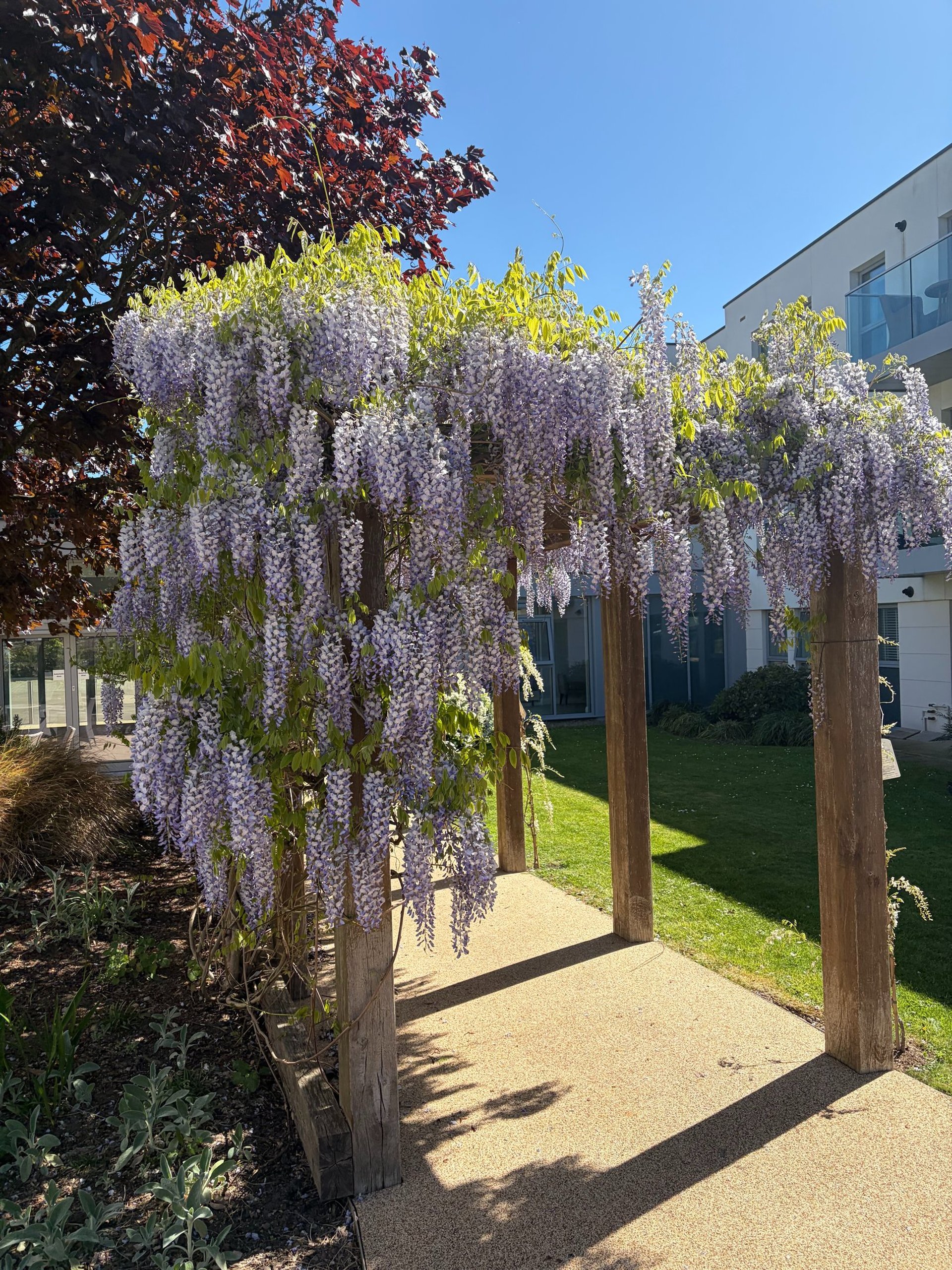
Today I'm spending part of the day pruning wisteria.
It's one of those jobs that arrives every summer, almost as predictably as the roses coming into flower or the lavender filling with bees. After enough years, the timing becomes second nature. You don't really need to look at the calendar. The plant tells you when it's ready.
Standing beneath a mature wisteria, secateurs in hand, I found myself thinking how different it is from so many other plants we grow. Wisteria has never been in a hurry. It grows steadily, quietly and often seems completely unconcerned by our expectations. Anyone who has planted a young one, hoping for a spectacular display the following spring, usually learns the same lesson.
Good things sometimes take time.
I suspect that's one reason so many people become frustrated with wisteria. We live in a world where we're used to seeing results quickly. We buy a plant, put it in the ground and naturally hope it will reward us almost immediately. Wisteria doesn't work like that. It asks for patience before almost anything else. In return, when it finally decides the time is right, it produces one of the most breathtaking displays you'll find in any garden.
Perhaps that's why I've grown to admire it.
After more than twenty years of gardening, I've realised that some of the finest gardens I've worked in weren't created in a single season. They evolved over years, sometimes decades. Trees slowly stretched their branches across a lawn. Shrubs settled into their space and began to look as though they'd always belonged there. Climbers reached windows they could never have touched in their first few years.
The garden was never rushing.
It was simply growing.
I sometimes think gardeners would be happier if we remembered that a little more often. It's easy to become disappointed because a new border doesn't yet look full or because a recently planted tree still feels rather small. But gardens have always worked to a different timetable from us. They're measured in seasons rather than days.
Looking after other people's gardens has reinforced that lesson again and again. I return month after month and year after year, watching places gradually mature. A border that looked sparse when first planted becomes rich and layered. A hedge that seemed little more than a row of sticks eventually provides privacy, shelter and a home for birds. The changes are so gradual that they're almost invisible until you stop and compare where the garden is now with where it began.
That's one of the quiet pleasures of gardening.
You don't always see the reward immediately.
Sometimes you have to trust that today's work is making next year's garden possible.
As I finished pruning the wisteria this morning, I realised that's exactly what I was doing. The flowers next spring aren't produced by a single afternoon's work in April. They're the result of everything that's happened over the previous year. Every careful cut, every season of growth and every patient decision quietly contributes to what comes next.
Gardens have always been rather good at teaching us that worthwhile things rarely happen overnight.
Perhaps that's why I never mind waiting.
After all, the best gardens I've ever known have all taken their time.
Marcus
Marcus Bergin
Thoughts, observations and conversations from a life spent in gardens.
© 2026. Marcus Bergin | All rights reserved.